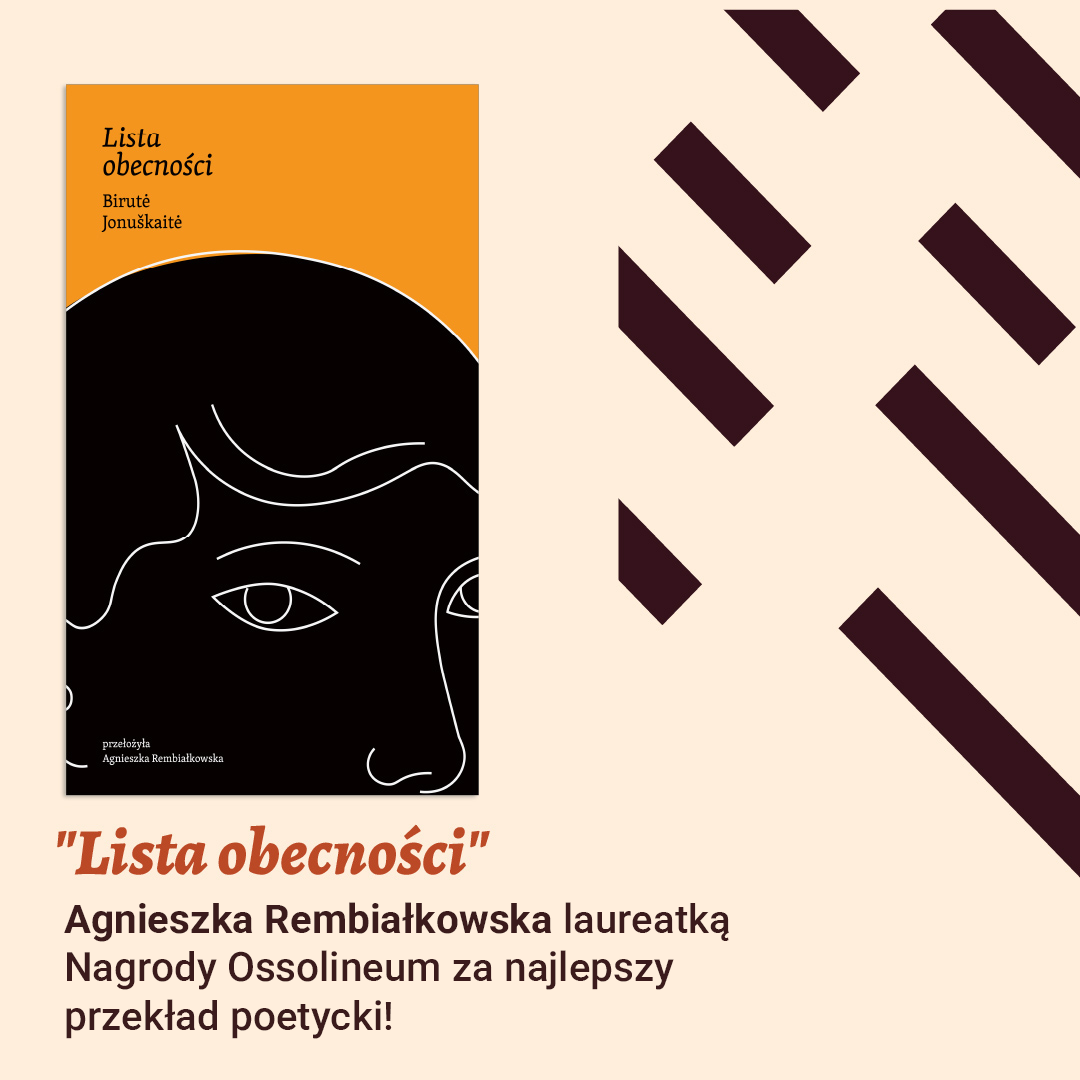
“Lista obecności” published by Warsztaty Kultury wins the Ossolineum Award for Poetic Translation 2026
The book “Lista obecności” by Birutė Jonuškaitė, translated by Agnieszka Rembiałkowska, has won the 2026 Ossolineum Award for Poetic Translation. This remarkable bilingual edition of poetry by the distinguished Lithuanian author has gained a second life in Polish language thanks to the meticulous and deeply sensitive work of the outstanding translator, Agnieszka Rembiałkowska.
The award jury selected the winner from among 28 poetry volumes submitted by 20 publishing houses from across Poland.
Agnieszka Rembiałkowska’s translation combines the alphabetical rigor of the titular attendance list with a masterful command of rhythm and meter, as well as an excellent understanding of the specificity of the Lithuanian cultural code in which Jonuškaitė’s poetry is deeply rooted. Technical discipline and cultural awareness were subordinated to conveying what matters most: the profound sensitivity and intimate voice of the original, the jurors wrote in their statement.
Agnieszka Rembiałkowska received a prize of 10,000 PLN and a commemorative statuette. A statuette will also be awarded to the publisher, Warsztaty Kultury.
About the translator
Agnieszka Rembiałkowska (born in 1980) is a Baltic studies scholar, academic lecturer affiliated, among others, with the University of Warsaw, as well as a translator and editor. She has been publishing literary translations from Lithuanian (and less frequently from Latvian) since 2005. She has participated in numerous translation seminars and workshops and has co-organized the Wiosna Poezji festival in Warsaw since 2016. She is a member of the Polish Literary Translators Association. In 2018, she received the translation award of the international literary festival Poezijos pavasaris for her translations of poetry books by Sigitas Geda, Nijolė Miliauskaitė (translated together with Alina Kuzborska), and Vladas Braziūnas. She was also awarded the Algis Kalėda Prize in 2022. She was nominated for the European Poet of Freedom Award in 2020 for her translation of the poetry collection “Właśnie:” by Agnė Žagrakalytė, and for the Gdynia Literary Prize in 2021 for her translation of the novel “Maranta” by Birutė Jonuškaitė.
About the author
Birutė Jonuškaitė was born into a Lithuanian family in the Sejny region. She is a poet, prose writer, essayist, and translator. She graduated in journalism from Vilnius University. She writes novels, short stories, and poetry, and translates Polish literature into Lithuanian. She has translated contemporary Polish poetry as well as novels by H. Krall, J. Dehnel, and M. Tulli, along with works by J. Rudnicki, M. Guśniowska, J. Korczak, M. Duszka, and B. Gruszka-Zych. For many years, she served as president of the Lithuanian Writers’ Union. She was also among the first scholars to study the work of Cz. Miłosz in post-independence Lithuania. She has received numerous literary and cultural awards. In 2006, she was honored with the Witold Hulewicz Award for fostering closer ties between Polish and Lithuanian literature, as well as the Gold Cross of Merit of the Republic of Poland. In 2020, she received the Baltic Assembly Prize for her literary work. In 2025, she was awarded the medal of the Order “For Merits to Lithuania” for her exceptional mastery of the Lithuanian language and her artistic portrayal of the people of her native region. Her short stories and poems have been translated into English, Polish, Georgian, Russian, Belarusian, Ukrainian, German, Spanish, French, Slovak, Slovenian, Greek, Czech, and Croatian. In Poland, her poetry collection “Dziecko o posiwiałych oczach” was published in 2004, followed by the novels “Maranta” (2020) and “Maestro” (2022).
About the book
“Lista obecności” is a collection of 70 poems — written by the author in the margins of life over the course of more than a decade — that forms a unique primer for reading women’s lives. The successive figures appear in alphabetical order: from the Altruist to the Life-Weary, grey-haired woman and the “assumption into heaven” marked with three asterisks. They come from different eras and various layers of culture — among them the goddess Liethua, Saint Veronica and a whole series of Veronicas, the nameless inhabitant of a sarcophagus in Reims, Manon and Madame Butterfly, rural women from the nineteenth century, and twentieth-century Lithuanian and Latvian women creators. There is no shortage of emigrants, artists and cleaners, villains and friends, or beloved relatives. They search for their identity; they create and destroy, fall in love, betray and suffer betrayal, cast spells upon the world, give birth, die, accompany others in death, and remember. They “materialize” within the narrative, which is not always spoken in the first person but is always empathetic — they deliver monologues, engage in dialogues, or emerge simply from a detail, an impression, or an artifact.